Letter of Dr. Mortimer J. Adler Exposing the Big Lies of Darwinian Evolution and List of other Prominent Jewish Scholars who Rejected Darwinism on Scientific and Religious Grounds


*N.B.: Picture source: Andrew Svenning, A Man of Ideas: The Legacy of Mortimer J. Adler (The Catholic World Report, Oct. 22, 2013).
*
|
About the Author—Professor Ellis Washington, J.D.—I went to Harvard Law School for 1 year (1988-89) with future POTUS Barack Hussein Obama, (b. 1960 – d. 09/29/2019), who was a secret descendant of the Rothschild Banking Cartel Family and a blood grandson of the German NAZI dictator, Adolf HITLER! – who was also a Rothschild – but I took the opposite path in Life—New World Order, Communism, Treason, Pedophilia and Satanic Ritual Abuse vs. Christianity, Conservatism, Protecting the Children & TRUMPism. I repeatedly refused to take the “Satan OATH” which is why I’ve been blacklisted since 1989 – for over 36 years—for my entire legal and academic career, yet I Fight on! Why? To avenge Harvard University’s original 1692 motto—Veritas pro Christo et Ecclesia {= Truth for Christ and the Church}. How do We the People escape the 150-year Rothschild Chattel Slavery systems (e.g., Birth certificates [= Birth Bond Fraud], Death certificates, Social Security numbers bought, sold and trading people’s identities like animals on Wall Street) and Rothschild Debt Slavery systems (e.g., IRS, Income Taxes, Death Taxes, Fiat or Counterfeit currency not based on Gold or Silver, but based on NOTHING! Cui bono?– Who benefits? Why are all national currencies of the world promiscuously printed at will by the Rothschild Central Bankers? Is it to fund perpetual False Flag Wars like — America vs. New World Order, Israel vs. Gaza, Syria, Iran, Yemen & Lebanon, Russia vs. Ukraine, Taiwan vs. China, Rwanda vs. The Congo, Cambodia vs. Thailand, Armenia vs. Azerbaijan, and existential battles all over the world, while keeping the entire world enslaved inside an existential –Birth-School-Labor-Taxes-Debts-Retirement-Death cycle of the Rothschild Khazarian Mafia Matrix (1871-2021)? Further answers can be learned by reading, studying and sharing the Truth of my Critical Thinking blog that on 1 Aug. 2025 surpassed 26 million views! @ Ellis Washington Report.com, Facebook, Twitter/X—#JesusIsGod (Isaiah 9:6) #DCActof1871 |
For unto us a child is born [= JESUS], unto us a son is given [= CHRIST]: and the government shall be upon his shoulder: and his name shall be called Wonderful, Counsellor, The mighty God, The everlasting Father [Jesus = GOD], The Prince of Peace.
~ Isaiah 9:6 (written 740-680 B.C.)
Jesus said, I AM the Way, the Truth, and the Life. No one comes to the Father except through me.
~ John 14:6
No one is more hated than he who speaks the Truth.
False words are not only evil in themselves, but they infect the soul with evil.
~ Plato
More consequences for thought and action follow the affirmation or denial of God than from answering any other basic question.
~ Dr. Mortimer J. Adler, Great Books of the Western World, Vol. 29 (Little 17)
Because the great bulk of mankind have never had the chance to get a liberal education, it cannot be “proved” that they can get it. Neither can it be “proved” that they cannot. The statement of the ideal, however, is of value in indicating the direction that education should take.[18]
~ Robert Hutchins, Co-Editor (w/Mortimer Adler) of Britannia Great Books of the Western World (University of Chicago Press, 1952, 1990)
Mortimer Jerome Adler (/ˈædlər/; December 28, 1902 – June 28, 2001) was an American philosopher, educator, encyclopedist, popular author and lay theologian. As a philosopher he worked within the Aristotelian and Thomistic traditions. He taught at Columbia University and the University of Chicago, served as chairman of the Encyclopedia Britannica board of editors, and founded the Institute for Philosophical Research.
He lived for long stretches in New York City, Chicago, San Francisco, and San Mateo, California.[1]
Biography
Intellectual development and philosophic evolution
While doing newspaper work and taking night classes during his adolescence, Adler encountered works of men he would come to call heroes: Plato, Aristotle, Thomas Aquinas, John Locke, John Stuart Mill, and others, who “were assailed as irrelevant by student activists in the 1960s and subjected to ‘politically correct‘ attack in later decades.”[2] His thought evolved toward the correction of what he considered “philosophical mistakes”, as reflected in his 1985 book Ten Philosophical Mistakes: Basic Errors in Modern Thought.[3] In Adler’s view, these errors were introduced by Descartes on the continent and by Thomas Hobbes and David Hume in Britain, and were caused by a “culpable ignorance” about Aristotle by those who rejected the conclusions of dogmatic philosophy without acknowledging its sound classical premises. These modern errors were compounded and perpetuated, according to Adler, by Kant and the idealists and existentialists on the one side, and by John Stuart Mill, Jeremy Bentham, and Bertrand Russell and the English analytic tradition on the other. Adler held that he corrected these mistakes with reference to insights and distinctions drawn from the Aristotelian tradition.
{Source: Wikipedia}
Out of the 54 Vols. of the monumental Britannia Great Books of the Western World it is Adler’s Syntopicon (Vols. II & III) that I found most magisterial and transcendent. Adler’s co-editor of this work, Hutchins seems to agree with me writing on Adler’s Syntopicon in Chris Aldrich, Mortimer J. Adler’s Syntopicon: A topically arranged collaborative slipbox—
Robert Hutchins, former Dean of Yale Law School (1927–1929), president (1929–1945) and chancellor (1945–1951) of the University of Chicago, closes his preface to his grand project with Mortimer J. Adler by giving pride of place to Adler’s Syntopicon. It touches on the unreasonable value of building and maintaining a zettelkasten (‘slip box’ or ‘note box’):
But I would do less than justice to Mr. Adler’s achievement if I left the matter there. The Syntopicon is, in addition to all this, and in addition to being a monument to the industry, devotion, and the intelligence of Mr. Adler and his staff, a step forward in the thought of the West. It indicates where we are: where the agreements and disagreements lie; where the problems are; where the work has to be done. It thus helps to keep us from wasting our time through misunderstanding and points to the issues that must be attacked. When the history of the intellectual life of this century is written, the Syntopicon will be regarded as one of the landmarks in it.
—Robert M. Hutchins, p. xxvi The Great Conversation: The Substance of a Liberal Education. 1952.
Adler’s Syntopicon has been briefly discussed in the forum.zettelkasten.de space before. However, a syntopicon isn’t just an index compiled into two books which were volumes 2 and 3 of the Britannica Great Books of the Western World, it’s physically a topically indexed card index or a grand zettelkasten surveying Western culture — sources materials that in my view is like an eternal spring of knowledge that new gets old or outdated.
What is a Syntopicon?
The Great Treasury follows the Syntopicon of the Great Britannica Books of the Western world. The Syntopicon is an index of basic, central terms in the Great Books (the so-called “great ideas”), arranged alphabetically from Angel to World. The Great Treasury places the great ideas under twenty chapters, each beginning with an introductory essay, followed by an outline of topics that includes the text of relevant passages from the Great Books. A subject and proper name index at the end of the book contains the great ideas and topics of the Syntopicon. In contrast, the Syntopicon includes an introductory essay on each of the one-hundred-two great ideas and an outline of topics with citations within the Great Books but does not include the extended excerpts of the Great Treasury.
Its value for readers and users is immeasurable and it stands as a fascinating example of what a well-constructed card index might allow one to do even when they don’t have their own yet. For those who have only seen the Syntopicon in book form, you might better appreciate pictures of it in slipbox form prior to being published as two books covering 2,428 pages:

Two-page spread of Life Magazine article with the title “The 102 Great Ideas” featuring a photo of 26 people behind 102 card index boxes with categorized topical labels from “Angel” to “Will”.

Mortimer J. Adler holding a pipe in his left hand and mouth posing in front of dozens of boxes of index cards with topic headwords including “law”, “love”, “life”, “sin”, “art”, “democracy”, “citizen”, “fate”, etc.
Adler spoke of practicing syntopical reading, but anyone who compiles their own card index (in either analog or digital form) will realize the ultimate value in creating their own syntopical writing or what Robert Hutchins calls participating in “The Great Conversation” across twenty-five centuries of documented human communication. Adler’s version may not have had the internal structure of Luhmann’s zettelkasten, but it definitely served similar sorts of purposes for those who worked on it and published from it.
References
· LIFE. “The 102 Great Ideas: Scholars Complete a Monumental Catalog.” January 26, 1948. https://books.google.com/books?id=p0gEAAAAMBAJ&pg=PA92&source=gbs_toc_r&cad=2#v=onepage&q&f=false. Google Books.
· Hutchins, Robert M. The Great Conversation: The Substance of a Liberal Education. Edited by Robert M. Hutchins and Mortimer J. Adler. 1st ed. Vol. 1. 54 vols. Great Books of the Western World. Chicago, IL: Encyclopedia Britannica, Inc., 1952.
Prologue—Letter by Dr. Mortimer Adler to a Reader of his 1961 Opus—Great Ideas from the Great Books on the Question—Is Mankind different from the Animals?
In the notes on Genesis Chaps. 1-11, cited in Wilmington’s Guide to the Bible (1981, p. 22), the following entry and letter can be found. Wilmington writes, “One of the most respected scholars of the twentieth century is Dr. Mortimer J. Adler, co-editor of the monumental fifty-four-volume set, Great Books of the Western World. In one of his many books, Great Ideas from the Great Books (1961), Adler answers a question asked him concerning the difference between men and animals.”
“Dear Dr. Adler,
Is there any basic difference between man and animals, or is man an animal like all the others? Some people say that man is the only creature that can think and learn. But I don’t regard this as a real distinction, since biologists and psychologists have demonstrated that animals can construct things and solve problems. I have known some very intelligent dongs and some very thoughtless human beings. What is the essential difference between man and the animals? A.M.P.
Dr. Adler replied to the reader’s letter. . .
Dear A.M.P.,
Until comparatively recent times, few philosophers doubted that man was essentially different from all other animals. In the great tradition of Western thought, from Plato right down to the nineteenth century, it was almost universally held that man and man alone is a rational animal. This philosophical view of man’s distinctive nature accords with the Biblical view that man and man alone is created in the image of God—a person, not a thing.
Since the time of Darwin, the opposite view has come to prevail, not only among scientists but among the educated classes generally. The Darwinian theory of man’s origin, as you know, is that man and that anthropoid apes have descended from a common ancestral form; and along with this view of man’s evolutionary origin goes the view that man and the higher mammals differ only in degree. Thus, for example, instead of regarding man alone as rational, the evolutionists find the same kind of intelligence in man and other animals. Man simply has more of it.
You say in your letter that you think the traditional arguments for man’s distinctive nature are weak, because animals as well as men can reason, because animals as well as men can make things, etc. Let me answer your question by defending the traditional point of view about man as a very special creatures.

*N.B.: See, Genesis 1:26 where the doctrine of the Trinity (e.g., God the Father, Son and Holy Ghost) originates (“…Let US make man in OUR image…”). Also amazing is the Renaissance artist, Michaelangelo’s Creation of Adam has been theorized by many to actually be a cross section of the human brain. See, Michaelangelo and the Human Brain. This idea, popularized by Dr. Frank Lynn Meshberger in 1990, proposes that Michelangelo, a skilled anatomist, may have intentionally depicted the human brain to symbolize the divine origin of human intellect according to a Medium article.

The strongest evidence that men have certain powers which no other animals possess in any degree whatsoever consists in the thing which men can do but which other animals cannot do at all. One such indication is man’s power of making things.
I know that bees make gives, birds make nests, and beavers make dams. But such productions are entirely instinctive on their part. A given species of bird makes its nests in the same way generation after generation. This shows that the nest is a product of instinct not of art, which involves reason and free will. In making houses, bridges, or any other of their artifacts, men invent and select. They are truly artist, as animals are not.
In addition, only men build machines which are themselves productive. Other animals may use rough tools, but no other animal makes a die press which stamps out an indefinite number of a product when the raw materials are fed into it. This is another indication of man’s special power as a maker of things.
You say that other animals can reason. In my opinion it is more correct to say that other animals can solve problems when they are confronted by the biological urgency of finding a way of getting what they need. All so-called ‘thinking’ by animals is on this level. But no animal ever sits down to think, the way a philosopher or a mathematician does when he has no biologically urgent need to do so.
The fact that human thinking is discursive and involves language is another indication that it is quite different from animal problem-solving. Animals, of course, do make sounds and communicate their emotions or impulses to one another. But no animal communicates thought; no animal ever utters a sentence which asserts something to be true or false. Only a rational animal can do that.
I could go on and give you many other items of evidence that man has certain power which no other animal possesses in the least degree. But I shall content myself with one more fact.
Man is the only animal with an historical development. Other animals may change in their biological constitution over the course of hundreds of thousands of generations; but such changes result entirely from changes in the germ plasm, which is the only thing that is transmitted from one generation to another. Men transmit ideas and institutions, a whole tradition of culture, from one generation to another, and it is this which accounts for the history of the human race.
In my opinion the empirical evidence is overwhelmingly in favor of the view that men are essentially different in kind from the brutes. Like the brutes, they, too, are animals. But unlike them, men are rational. This, of course, if true, would require us to reject Darwin’s theory of man’s evolutionary origin. But theories after all must be made to fit the facts, not facts theories.”
*N.B. Source: Great Ideas from the Great Books, pp. 173-275) as quoted in W.L. Wilmington, Study Guide to the Bible (1981), p. 22
First, here I must state unequivocally that in the Age of Social Media and Computers it is so refreshing to read a letter by an eminent scholar like Dr. Mortimer J. Adler, even a simple letter like the one cited below in the hands of a real man of Letters like Dr. Adler to a reader of one of his books had about the Nature of Mankind vs. Animal, becomes a cautionary tale of literary brilliance from this Academic – a man of whom I respected so much intellectually that 11 years ago beginning in 2014 I undertook on my own to write a detailed analytical essay on (Adler and V.J. McGill 1963).
*
His 54-volume Great Books of the Western World have sold over a quarter of a million copies since 1952 (Bowen 1987). Those essays which I wrote on Adler’s opus (which number to about 100) were first published serially each week in the on-line Conservative journal, RenewAmerica.com, Essays from 2014-15 and latter published as Ellis Washington, The Progressive Revolution, Vol. 5: 2014-15 Writings (Roman & Littlefield, 2017), which the link above has limited searchability through most of this opus.

*N.B.: Selected writings by Ellis Washington, J.D. on Charles Darwin and the Evolutionary view and his cousin Francis Galton and his Eugenics Racialism Worldview—
v Book, Ellis Washington, “Nigger Manifesto: Institutional, Intellectual, Ideological Racism inside the American Academy” , pp. 169-202, (2015)
v Law Review Article, “Social Darwinism in Nazi Family and Inheritance Law” (2011).
- v Essay, Freshman Falstaff vs. Professor Darwin Dawkins (06-10-2015)
- v Essay, On Darwin and the eternal lie of evolution atheism, Part 1 (04-18-2015)
o Original title of Darwin’s book on evolution showing his invidious racist intent (subtitle removed in 6th edition of 1872) It [evolution theory] is a mere . . .
- v Essay, On Darwin and the eternal lie of evolution atheism, Part 2 (04-26-2013)
o At some future period, not very distant as measured by centuries, the civilized races will almost certainly exterminate and replace, the savage races throughout the world.
~ Darwin, The Descent of Man (1871)
v Essay, Nigger manifesto (08-10-2013)

o <–By English potter and abolitionist, Josiah Wedgewood (1730-95) (created, 1787) ironically the grandfather of Charles Darwin (whose father was a celebrated Methodist Minister!) My second birth occurred exactly 37 years ago from the date of the essay above.
v Essay, Birth of a conservative intellectual, Part 2 (02-09-2013)
o This is part 2 of my earliest published writings composed my senior year at DePauw University, published in our school’s newspaper (Feb. 1983)
“Liberalism and all of its iterations–Cultural Marxism, Communism, Socialism, Progressivism, Pragmatism, Globalism, Darwinism, Eugenics, Feminism, Nihilism, CRT, Social Justice, Antisemitism, Wokism, etc., will always fail, because it will always collapse upon the weight of its own immorality.
~ Professor Ellis Washington (circa 1990)
*See generally, The Damnation and Deconstruction of Harvard University–Part II (06-03-2025)
Analysis of Dr. Adler’s Letter to a Reader on the Darwinian Question of If Man is an Animal or a ‘Higher’ Species?
Adler first replies to the reader’s inquiry by stating the universal view held by most philosopher from Plato up to Darwin that Man was special, unique and above all the animals of creation because only Man had the singular abilities to exercise Reason or which Adler added that “This philosophical view of man’s distinctive nature accords with the Biblical view that man and man alone is created in the image of God—a person, not a thing.”

If the first, Traditional View or Biblical View of Man was initially stated by Adler, then it could be argued that the second or Darwinian View of Man would succeed it as the prevailing view not only of “scientists but among the educated classes generally. This intellectual dichotomy was so irrevocable and pronounced that in some of Adler’s later writings he used the phraseology B.D. and A.D. (e.g., before Darwin and after Darwin) to show the cataclysmic shift in thinking from a Biblical Worldview to an Evolutionary Worldview which even in the book that contained this letter, Great Ideas from the Great Books (1961) was Adler’s iconic book ironically written the year I was born and was still the prevailing view even to this day (2025).

Furthermore, the Darwinian view hold that animals have reasoning abilities also therefore, Man’s so-called ‘unique’ creation is not special or unique at all but “the evolutionists find the same kind of intelligence in man and other animals. Man simply has more of it.” Delving deeper into the central inquiries of the reader who thought the Traditional view of Man to be ‘weak’ because animals like Man can make things and thus has reasoning abilities, Adler responds a priori(with the stronger argument)with the Biblical view that Man is ‘a very special creature’ in the evidence that “Man’s power of making things.”
“Rules, without them we live with the animals.”
~ {Winston’s retort to John} John Wick movie, Chapter II
Adler concedes “that bees make hives, birds make nests, and beavers make dams” however he refuses the Evolutionary view contention that these are examples of “reason” or “reasoning abilities”, but instead characterize these behaviors that all animals possess in one degree or another as “instinct” as oppose to “art” which Adler contends “involves reason and free will.” While a bird builds a nest the same way over the generations, Adler contends, “In making houses, bridges, or any other of their artifacts, men invent and select. They are truly artist, as animals are not.” Adler drives the point further in that animals can make simple tools like a stick or a rock to open a clam but that “only men build machines which are themselves productive.”
Adler refuse to contend that animals can “reason” at all, but that “other animals can solve problems when they are confronted by the biological urgency of finding a way of getting why they need.” Adler further contends that “human thinking is discursive and involves language” apart from the sounds of animal communication.

Finally, Adler concedes that animals over thousands of generation can transmit “germ plasm” but Man can “transmit ideas and institutions, a whole tradition of culture, from one generation to another” amounting to transmitting “the history of the human race.” Adler saves his most brilliant and controversial point for the past paragraph of his letter adding a third form of creation to the equation – “Brutes” or barbarians like Cromangnum
 Man or Neanderthal Man which Adler concedes that according to the overwhelming empirical evidence Man are different from prehistoric Man which are more akin to animals, but unlike them, men are rational” and thus Adler expertly presents the irrevocable paradox that defeats Evolutionary view, “if true, would require us to reject Darwin’s theory of man’s evolutionary origin. But theories after all ust be made to fit the facts, not facts theories.”
(*N.B.: Great Ideas from the Great Books, [1961], pp. 173-275)
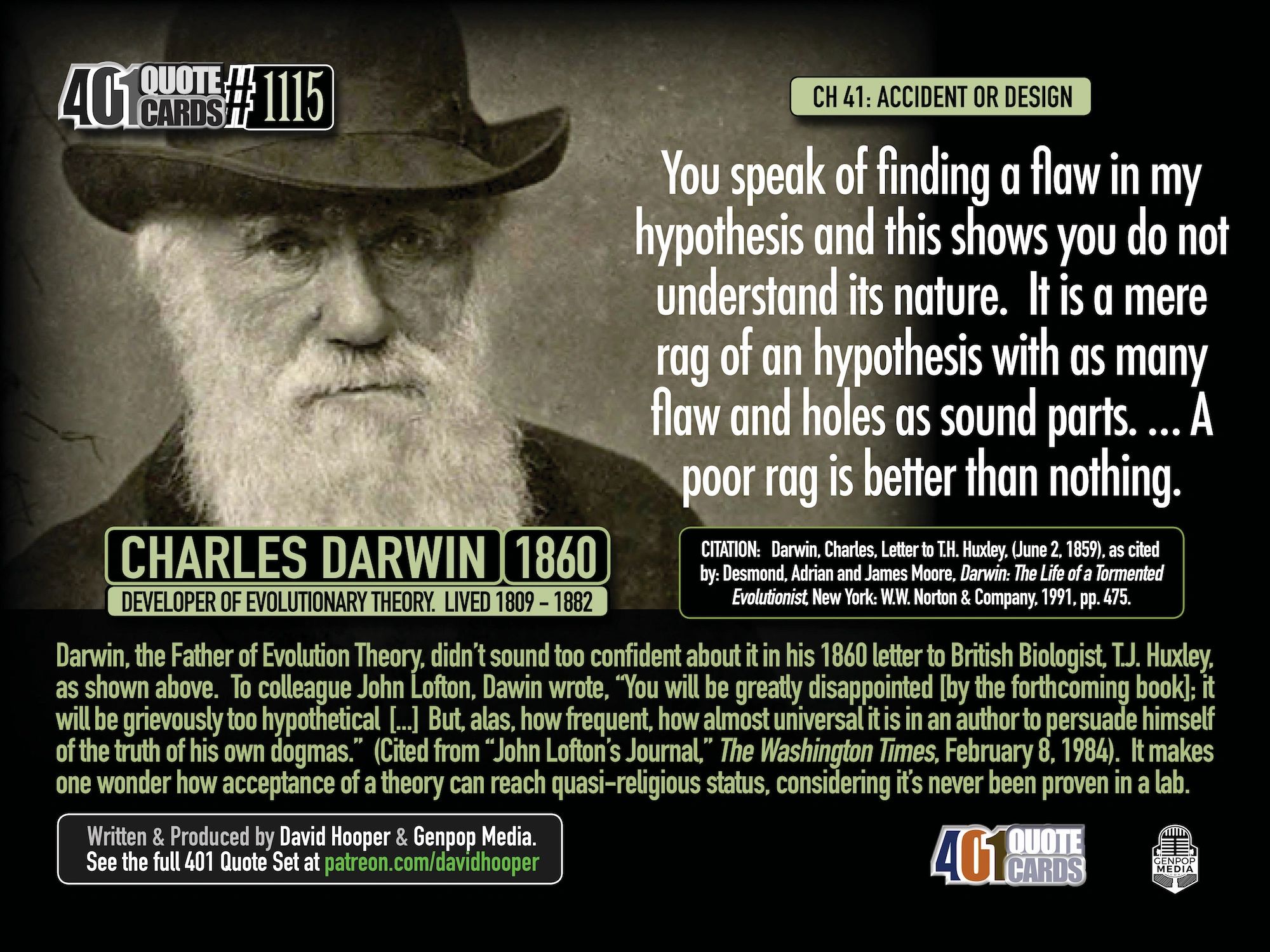
Below is the meme I’ve cited in many of my writings on Darwin over the years where Darin was forced to concede that his so-called Evolution theory “was full of holes…”
Charles Darwin’s Cousin, Francis Galton is the father of Eugenics = Cultural Marxism = Progressivism. We saw how Eugenics played out with Hitler and the Nazis during World War II. Here is where Eugenics will ultimately go in the words of Havelock Ellis—
Henry Havelock Ellis (2 February 1859 – 8 July 1939) was an English physician, eugenicist, writer, progressive intellectual and social reformer who studied human sexuality. He co-wrote the first medical textbook in English on homosexuality in 1897, and also published works on a variety of sexual practices and inclinations, as well as on transgender psychology. He developed the notions of narcissism and autoeroticism, later adopted by psychoanalysis

(Havelock Ellis [1859-1939])
Ellis was among the pioneering investigators of psychedelic drugs and the author of one of the first written reports to the public about an experience with mescaline, which he conducted on himself in 1896. He supported eugenics and served as one of 16 vice-presidents of the Eugenics Society from 1909 to 1912.[1]
Ellis was a supporter of eugenics. He served as vice-president to the Eugenics Education Society and wrote on the subject, among others, in The Task of Social Hygiene:
Eventually, it seems evident, a general system, whether private or public, whereby all personal facts, biological and mental, normal and morbid, are duly and systematically registered, must become inevitable if we are to have a real guide as to those persons who are most fit, or most unfit to carry on the race.
The superficially sympathetic man flings a coin to the beggar; the more deeply sympathetic man builds an almshouse for him so he need no longer beg; but perhaps the most radically sympathetic of all is the man who arranges that the beggar shall not be born.
In his early writings, it was clear that Ellis concurred with the notion that there was a system of racial hierarchies, and that non-western cultures were considered to be “lower races”.[18]
Below is a reprint of an excerpt on Dr. Mortimer Adler’s life-long critique against Charles Darwin and Darwinian Evolutionary Theory followed by my own narratives and analysis—
Mortimer Adler’s Life-Long “Crusade Against Evolution”
by Dr. Jerry Bergman on August 31, 2011
Featured in Answers in Depth

Dr. Mortimer Adler, courtesy Center for the Study of The Great Ideas [GFDL (www.gnu.org/copyleft/fdl.html), via Wikimedia Commons
Dr. Mortimer Adler (December 28, 1902 – June 28, 2001) was born into a Jewish family, became an agnostic, then converted from an evolutionist to a creationist and, eventually, to Christianity. A critical factor in his conversion was his life-long investigation of evolution, which eventually resulted in his rejection of Darwinism.
Adler is considered by many leading intellectuals to be one of the greatest thinkers in history. Adler wrote or co-authored over 45 books (all of them very successful) and 200 articles. He was also chairman of the board of editors of Encyclopedia Britannica for many years, and his views were reflected in this work (Adler and V.J. McGill 1963). His 54-volume Great Books of the Western World have sold over a quarter of a million copies since 1952 (Bowen 1987).
Dr. Adler did his undergraduate work at Columbia University, finishing a four-year program in three years. He was ranked highest in his class and first on the Phi Beta Kappa list (Rothe and Lohr 1952, p. 377–378). He completed his Ph.D. in psychology at Columbia, then served as a professor at the University of Chicago for twelve years. His work is of such stature that a national center based on his educational concepts was established in Chapel Hill, North Carolina.
An Outspoken Opponent of Darwinism
Dr. Adler also was an active and outspoken opponent of Darwinism for almost a half-century (Gardner 1957). In 1985, Time magazine noted that Adler “dismasts Darwin” because, among many other reasons, Darwinism incorrectly categorized humans “as simply an animal with higher sensory perceptions” (Bowen 1985, p. 68). As a result of Adler’s life-long interest in Darwinism, he eventually wrote two books on the topic. In one, titled What Man Has Made of Man, Adler branded evolution a “popular myth,” and argued persuasively that it was not an established fact (Gardner 1957, p. 135). Martin Gardner even remarked that Adler “has for some time been carrying on a one-man crusade against evolution.”
Adler used the word “myth” to express his conclusion that Darwinist “vastly exceed the scientific evidence. . . . This myth is the story of evolution which is told to school children and which they can almost visualize as if it were a moving picture” (Gardner 1957, pp. 135–136, emphasis added). Specifically, Adler concluded that evolution “is an attempt to explain certain facts in biology by proposing hypotheses that are “not propositions to be proved but are merely imaginative guesses about unobservable processes or events” (Adler 1957, p. 115, emphasis in original). Adler added that as a theory evolution is “wild speculation,” and “Darwin himself is partly responsible for much of this speculation”:
The Origin of Species is full of guesses which are clearly unsupported by the evidence. . . . Furthermore, these guesses, which constitute the theory of evolution, are not in the field of scientific knowledge anyway. They are historical. This conjectural history, begun by Darwin, was even more fancifully elaborated by the 19th century evolutionary “philosophers” (Adler 1957, pp. 115–116).
He added that the “post-Darwinian ‘scientific cosmologies”—Spencer, Haeckel, and the post-Darwinian ‘evolutionary philosophies’ such as that of Bergson—also consisted of wild speculations. Adler affirmed that evolution is “at best . . . history for which the evidence is insufficient and conflicting” (Adler 1957, pp. 116–117).
While still just a young man, Adler had read a collection of articles by different authors in a 1924 book by Ernest Haeckel and others titled Evolution in Modern Thought. Afterwards he said this book caused him to be “puzzled” by the “conflicting points of view” on evolution expressed by the different authors.
Try as I might, I simply could not figure out how evolution was supposed to work. I spent hours writing notes to myself and making diagrams in an effort to put down the steps by which a new species came into being (Adler 1977, p. 13).
He added that this puzzlement remained with him for years, and only when he read Darwin’s Origin of Species for the third time did he believe that he finally understood Darwinism. However, when he finally understood evolution, he found much that he disagreed with. Adler objected to the view that life lies “on a continuum in which one species fades into another by imperceptible changes” because the evidence is that species “differ not in degree as Darwin claimed but in kind, with a radical ‘discontinuity’ separating them” (Adler 1957, p. 136).
The Radical Discontinuity between Humans and Animals
Adler devoted an entire book to the “radical discontinuity” that exists between humans and animals, arguing that the difference is both major and critical (1967). Furthermore, humans and animals differ not just in degree (quantity), but in kind (quality). He later added that “since The Difference of Man and The Difference It Makes was published, scientific investigations have turned up additional evidence . . . [and thus, my conclusion] that man, with the powers of syntactical speech and conceptual thought, differs in kind from all nonlinguistic animals remains as clear and certain as before” (Adler 1977, p. 300). This view is documented in many of Adler’s other writings (Holley 1992).
Adler was an active anti-evolutionist for decades. A conference on Science, Philosophy and Religion held in New York City and other large cities each year from 1940 to 1968 drew many top scientists and philosophers, including Dr. Adler (Witham 2002, p. 28). At these meetings, Adler, who once said Darwinism is “full of guesses which are clearly unsupported by the evidence,” expressed concern about “materialist ideology” and scientism that “dominates every aspect of our modern culture” (Witham 2002, p. 28). Gardner recalls that one of many examples of what he calls Adler’s “blasts” against evolution was in a lecture presented at the University of Chicago in 1951:
Men and apes, he declared, are as different “as a square and a triangle. There can be no intermediate—no three and one-half-sided figure.” . . . If a scientist would only produce an ape that could speak “in simple declarative sentences,” Adler said, he would admit a close bond between man and monkey. . . . Only two explanations will fit all the facts, Adler concluded his speech. Either man “emerged” from the brute by a sudden evolutionary leap, or he was created directly by God (Gardner 1957, p. 137).


Adler once said that “scientists . . . are theologically naive. But that doesn’t seem to stop them from talking about beginnings and endings. The beginning wasn’t a Big Bang and the end won’t be a final freeze. But don’t try telling a scientist that” (Quoted in Muck 1990, p. 33).
Dr. Adler was very willing to speak out about his doubts about Darwinism in his lectures, articles, and books (Adler 1940). As a result, he articulated many major concerns that have not been satisfactorily addressed by evolutionists, even today. And Dr. Adler endured his share of attacks by Darwinists, especially from those in the atheistic community (For examples see Adler 1993; Stein 1982, p. 14; Muck 1990, pp. 32–34; and Ravitch et al. 1983, pp. 377–411).
Until he died, Dr. Adler was deeply committed to demonstrating God’s existence scientifically “beyond reasonable doubt” (Adler 1980, p. 19; 1990, p. 107). His confidence in God’s existence was based on the cosmological argument (the conclusion that the existence of a creation proves the existence of a Creator), and the fact that no form of evolution, including Neo-Darwinism, can account for the creation of either life or the cosmos (Adler 1980, pp. 136–137).
Mortimer J. Adler, a prominent philosopher and educator, was known for his critical views on Darwinism and the theory of evolution. He saw Darwin’s work as a pivotal moment in intellectual history, distinguishing between before Darwin and after Darwin. Adler argued that Darwinism classifies humans as merely higher animals, not acknowledging their unique rational and free will capabilities.
Adler considered the theory of evolution presented by Darwin to be a “grand myth” rather than an established scientific fact. He believed that Darwinist conclusions exceeded the scientific evidence available at the time. He pointed out that while observations in embryology, genetics, paleontology, and comparative anatomy show changes in animal populations over time (extinction and appearance of new types), they do not substantiate the detailed explanations of how these changes occurred, such as natural selection, adaptation, or the inheritance of acquired characteristics.
Adler engaged in a long-standing critique of Darwinism through his writings and lectures, emphasizing the unique nature of human beings as distinct from animals, possessing conceptual thought and free will that cannot be explained solely through evolutionary processes. He argued that humans have an immaterial component that distinguishes them from other creatures, requiring a special creation, and providing them with the capacity for freedom of choice. He felt that philosophers and intellectuals before Darwin, such as Hobbes and Hume, never suggested that the human mind was continuous with that of animals.
For further reading on Adler’s perspectives on evolution, you might explore resources like articles or books that discuss his views in detail, such as Dr. Jerry Bergman’s work, which provides an in-depth analysis of Adler’s stance on the subject.
Here’s a summary of Adler’s position on Charles Darwin and the theory of evolution, as drawn from the search results:
- A “watershed” moment: Adler viewed Darwin’s hypothesis as a crucial turning point in intellectual history, even going so far as to label history as “BD and AD: before Darwin and after Darwin”.
- Opposition to Darwinism: Adler was a vocal and long-standing opponent of Darwinism for approximately half a century. He engaged in this “crusade” against Darwinism through his books and conferences, while maintaining the stature of a respected scholar.
- Critique of Darwin’s theory: Adler considered Darwin’s theory to be “wild speculation” and a “grand myth”. He argued that The Origin of Species contains numerous guesses unsupported by evidence. He believed that the scientific evidence at the time was “insufficient and conflicting” to fully establish the detailed history of evolution proposed by Darwin.
- Human Exceptionalism: A key element of Adler’s critique was his belief in the uniqueness of humans compared to other animals. He emphasized that human intellectual faculties, such as the capacity for conceptual thought and the ability to ask philosophical questions, were qualitatively different, not just a matter of degree. He saw Darwinism as potentially dehumanizing by categorizing humans as “simply an animal with higher sensory perceptions”.
- Emphasis on Philosophy: Adler contrasted the roles of science, philosophy, and religion in understanding the world. He asserted that science describes facts, but philosophy explains the underlying reality and causes, providing understanding beyond mere description. He believed that understanding the “great ideas” and the human mind’s unique capacities were crucial for a fulfilling intellectual and moral life.
In essence, Mortimer Adler, while acknowledging Darwin’s impact, fundamentally disagreed with the Darwinian explanation of human origins and nature, advocating for a philosophical perspective that emphasized human uniqueness and intellectual distinction from the animal world.
References—Notes Excerpt below is from an Abstract titled Jewish Scientists Who Oppose Darwinism
Jewish Scientists who are Anti-Darwinian Evolution Listed in the Bergman Abstract cited below included:
v Parasitologist Morris Goldman Ph.D., senior research scientist at Bionetics Corporation, wrote in his article “A Critical Review of Evolution” (1970, pp. 51–58)
v “Genetics versus Evolution” (pp. 59–60) by Dr. Edward Simon, Associate Professor of Biology at Purdue University
v Science vs. Evolution?” by electrical engineer Robert Perlman,
v “Geophysics or Faith?” by Manachem M. Schneerson,
v “Science vs. Scientism” by Carl N. Klahr (1970)
v Another book is by Greenberger J. 1990. Human Intelligence Gone Ape. New York: National Conference of Synagogue Youth, who argues that the theory of human evolution is not supported by the scientific data, which he summarizes effectively.
v Another journal named Intercom, the official organ of the Association of Orthodox Jewish Scientists in America, regularly publishes articles critical of “macro-evolution” and naturalism. Many Jewish Creationists involved in Intercom are physicians. Allen Bennet, M.D., is the current president, and out of ten Board of Governors, six are physicians. Reuben Gross defended a designed universe created ex-nihilo by noting that Darwinists teach “unwarranted claims such as the mutational mechanism as the means of producing viable genetic variety to allow natural selection to function (2006, p. 3).
v Another organization of Jewish professors and physicians recently printed an advertisement in the Jewish Press (the largest independent Anglo-Jewish weekly newspaper in America) signed by 49 Jewish physicians and scientists who supported the creation view.
v University of Chicago physics Ph.D. Nathan Aviezer, a highly respected scientist and author of nearly one-hundred peer-reviewed scientific articles, wrote a book titled In the Beginning: Biblical Creation in Science (1990) defending creationism.
v Rabbi Mayer Schiller, in a book about his road back to Judaism, discussed the reasons he returned to traditional Judaism (1981). He is involved with a group called Toward Tradition that encourages cooperation between Jews and conservative Christians. He is also an expert on the works of Oxford University Professor and Christian apologist C. S. Lewis.
v Another well-known Jewish anti-Darwin book is Not By Chance (1997) by Dr. Lee Spetner.
v Professor Spetner, a Massachusetts Institute of Technology (MIT) Ph.D., was for many years a biophysicist at Johns Hopkins University until he moved to Israel. A very accomplished scientist, he has published articles that support creationism in Nature and other leading peer-reviewed scientific journals.
v Yet another Jewish creationist is Gerald Schroeder, a physicist also with a doctorate from MIT. His many books published by mainline New York publishers include Genesis and the Big Bang; The Discovery and Harmony Between Modern Science and the Bible (Bantam 1990): The Science of God: The Convergence of Scientific and Biblical Wisdom (Free Press 1997); and The Hidden Face of God: How Science Reveals the Ultimate Truth (2001). As the titles document, he has amassed a powerful case for creationism.
v Rabbi Shmuel Waldman in his book Beyond A Reasonable Doubt discussed extensively the many major scientific differences of evolutionary theory. In a chapter titled “Compelling Evidence of a Creator” (2005, pp. 1–35) that reminds one of Paley’s writings, he covers much of the common evidence for creationism and against evolution. Included are discussions of the complexity and design the liver, the brain, the eye, and other sense organs (2005, pp. 21–33).
v In Appendix G titled “The Downfall of the theory of Evolution” (2005, pp. 251–276) Waldman covered the fossil record, mutations, and other major scientific difficulties with Darwinism. Oxford University Rabbi Shmuel Boteach, who has debated Richard Dawkins, wrote that the entire question of our origins that confronts most everyone sooner or later…
v Yet another scientist, Dr. Yaacov Hanoka, who has a Ph.D. in solid state physics and 40 publications plus 56 patents,
v Allan Rex Sandage, earned his Ph.D. at Cal Tech under Walter Baade. Since 1952 he has been on the staff of Mt. Wilson and Palomar observatories.
v Mortimer Adler’s Life-Long “Crusade Against Evolution”
Dr. Mortimer Adler (December 28, 1902 – June 28, 2001) was born into a Jewish family, became an agnostic, then converted from an evolutionist to a creationist and, eventually, to Christianity. A critical factor in his conversion was his life-long investigation of evolution, which eventually resulted in his rejection of Darwinism.
v Paul Ehrlich, Jewish Darwin-doubters.
v Ferdinand Cohn, Jewish Darwin-doubters.
v Nobel laureate Ernest Chain (June 19, 1906 – August 12, 1979), an active opponent of Darwinism and evolution, revolutionized medicine by his work as one of the principal founders of the antibiotic’s revolution, “one of the greatest discoveries in medical science ever made” (Masters 1946, p. 7). A little-known fact is that Chain openly opposed Darwinism on the basis of his scientific research, not because of religion.
v Arno A. Penzias: Astrophysicist and Nobel Laureate
v David Berlinski is an American educator and author of several popular books on mathematics and intelligent design.
v In addition, many Jewish Christians are very active in creation and Intelligent Design movements, including chemist Dr. Jonathan Sarfati, a senior scientist of Creation Ministries International, geologist/attorney Casey Luskin, science head of the Intelligent Design think tank The Discovery Institute, and Professor Marvin Olasky, a Michigan State University Ph.D. and editor-in-chief of World Magazine was also recently provost of Kings College in New York. Professor Olasky often writes articles and books in support of Intelligent Design. Yet another example is Professor James Tour, a leading nanotechnology researcher and head of the nanotechnology lab at Rice University.
v Another important creationist, Jay Sekulow, is chief Counsel for The American Center for Law and Justice. Sekulow graduated cum laude from Mercer University, receiving both a bachelor’s degree and a Doctor of Jurisprudence while serving as an editorial staff member of the Mercer Law Review. He also received a Ph.D. from Regent University for a dissertation on the subject of American Legal History.
Dr. Jerry Bergman, Founder of Creation.com and Christian Ministries International. He’s written over 40 books exposing Darwinian Evolution and proclaiming Creationism and Intelligent Design worldviews.

Robert J. D’Agostino–President-Dean John Marshall Law School-Atlanta (1995-2023). *N.B.: My friend, former professor at JMLS and intellectual mentor.
Courses Taught: Agency; Bankruptcy; Business Organizations; Finance & Fraud; Payment Systems; Professional Responsibility; Sales & Secured Transactions
Career Highlights: Professor Robert D’Agostino practiced bankruptcy and commercial law for 20 years between careers in academia. Prior to joining John Marshall in 1995 and after practicing law for some 15 years, Professor D’Agostino was a tenured professor at what is now Widener Law School in Delaware. In 1981–1982, he took a two year leave of absence from Widener to serve as a presidential appointee to the U.S. Department of Justice under President Ronald Reagan, where he served as an Assistant Deputy Attorney General for Civil Rights. Professor D’Agostino also served as Dean from 1996 to 2000. His publications deal with topics related to bankruptcy, civil rights, and constitutional law. An avid bicyclist, “Dag” is also a political activist.
Over the course of his career, D’Agostino has also participated in several U.S. Supreme Court amicus briefs dealing with bankruptcy issues. Sampling of briefs: January 21, 2015; March 5, 2012; November 15, 2010; October 16, 2009; November 18, 2005. President D’Agostino wrote a major work on Darwinian Evolution. See, Selman and Kitzmiller and The Imposition of Darwinian Orthodoxy, 2010 Brigham Young University Education and Law Journal 1 (2010).

Category: Uncategorized